Story
Unitree did not invent the humanoid robot. It invented the affordable humanoid robot. The H1 lists at a price an order of magnitude below its American competitors, and unlike them, the company publishes a real spec sheet — dimensions, joint torque, battery capacity, sensor stack — on its product page. Unitree's Chinese page now presents an H1-2 variant alongside H1, but HumanoidRoster keeps base H1 specs intact unless the profile is explicitly expanded into variant specs.
The company's lineage is in legged quadrupeds — Go1, Go2 — which have been shipping to research labs and consumers for years. Unitree knows how to manufacture legged machines at volume. The H1 is the company's bet that the same supply chain, scaled up two legs at a time, will commoditize humanoid hardware before American competitors can finish their first commercial fleets.
The Reality Score is held back by transparency. Specs are published — that part is solid. What's not solid is Western editor and analyst access to Unitree's facilities and engineering team. The hardware is verifiable through public sales; the company itself is not.
Reality check
Unitree publishes specs, dimensions, and joint torque on its product page. The hardware is real and so is the sales pipeline. Western verification access remains narrower than for US/EU competitors. High-speed sprint demos are tracked separately from the official 3.3 m/s product-page top speed.
- Manufacturer spec sheet — ~180 cm, ~47 kg, 22 DoF, 864 Wh battery, 3.3 m/s top speed
- Real units shipped to academic and research customers worldwide
- Lineage from Unitree's Go2 quadruped — proven supply chain at volume
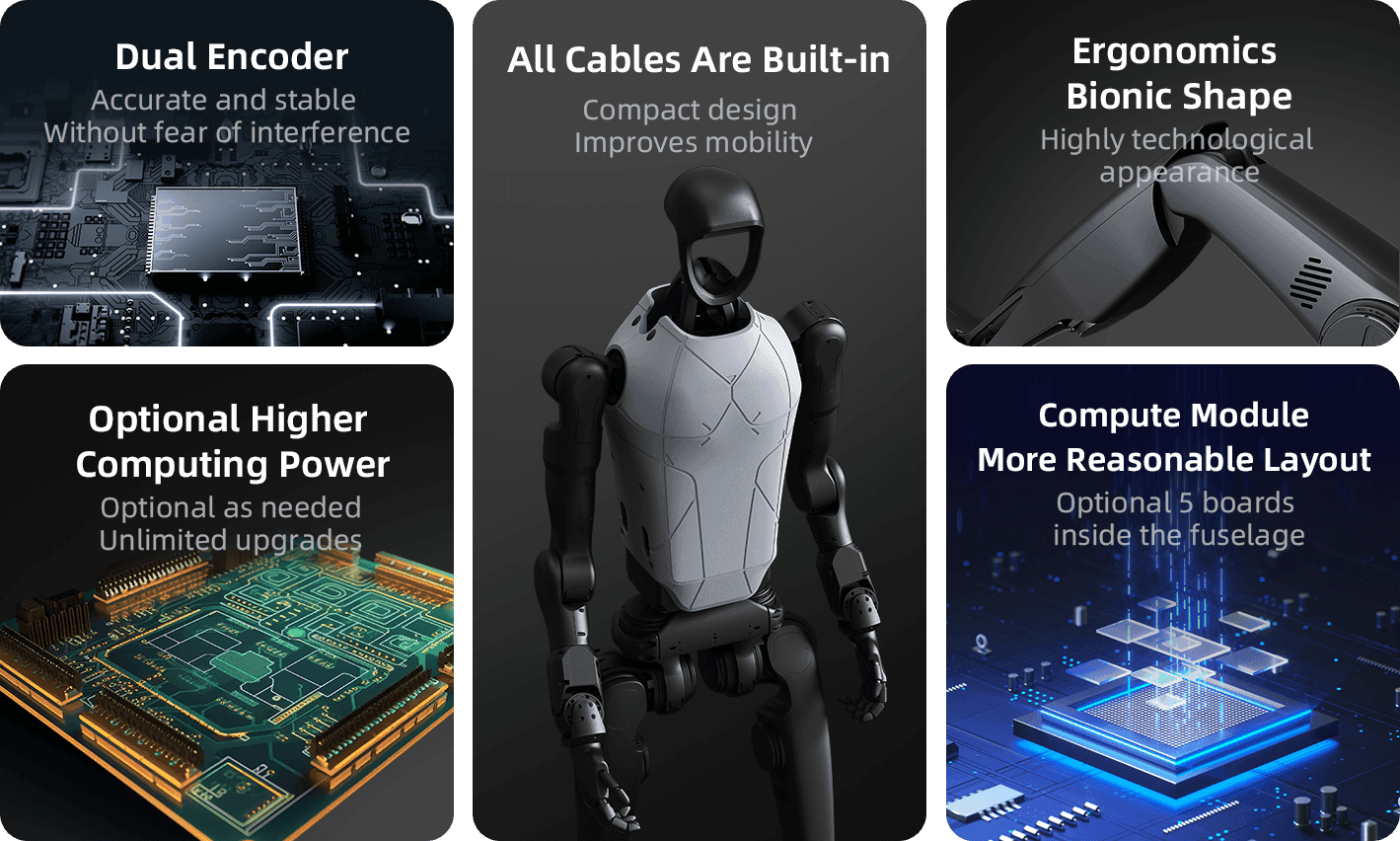
- Optional Intel i7 or Nvidia Jetson Orin NX compute, optional dexterous hand upgrade
- Unitree's Chinese product page now presents H1 / H1-2, with H1-2 listed separately at ~178 cm, ~70 kg, 27 DoF, 3D LiDAR + depth camera, 7-DoF arms, and a stronger/larger full-size configuration
- Unitree published April 2026 H1 performance and Beijing Humanoid Robot Marathon participation updates
- CNRS–AIST Joint Robotics Laboratory researchers tested an Acc-CBF-QP runtime safety filter on a 19-DoF Unitree H1; across approximately one-minute real-robot runs, the paper reports 10.04 constraint violations per second for the Safe-RL policy alone and 0.80 per second with the TorqueTask filter, a reduction of about 92%
- The PR-MPPI preprint shows an author-run physical demonstration on the two 7-DoF arms of a Unitree H1-2. The robot held a loaded tray with both hands while a person advanced a hand-held obstacle from varying directions. The obstacle position was supplied to the controller each cycle; PR-MPPI replanned at 30 Hz while a computed-torque law tracked its commands at a 500 Hz state rate. The paper reports that the shown controller reshaped the arms to open clearance while maintaining the closed-chain tray grasp and keeping the measured tray level.
- Long-duration uptime claims rely on Unitree's own internal logs, not third-party validation
- April 2026 sprint demo reports around 10.1 m/s, with measurement-error caveats; this should not replace the official 3.3 m/s spec-sheet top speed
- H1-2 appears to be a variant on Unitree's H1 page; its larger specs should not overwrite the base H1 profile or be treated as a separate tracked robot without editorial approval
- The safety-filter paper controlled only H1 leg joints while the arms and torso remained static; 0.80 violations per second is not zero, and the result is not a certified product-safety, production-controller, general-autonomy, or deployment benchmark
- The PR-MPPI H1-2 section is qualitative: it publishes no physical trial count, success rate, payload mass, obstacle-position sensing method, operator/spotter/intervention/reset accounting, or independent replication. The paper's 30 randomized obstacle placements, success counts, and baseline comparisons were run on dual Franka arms in MuJoCo and must not be attributed to H1-2. Reactive replanning from a supplied obstacle position is not autonomous task selection, perception validation, stock-H1-2 capability, customer deployment, or production safety.