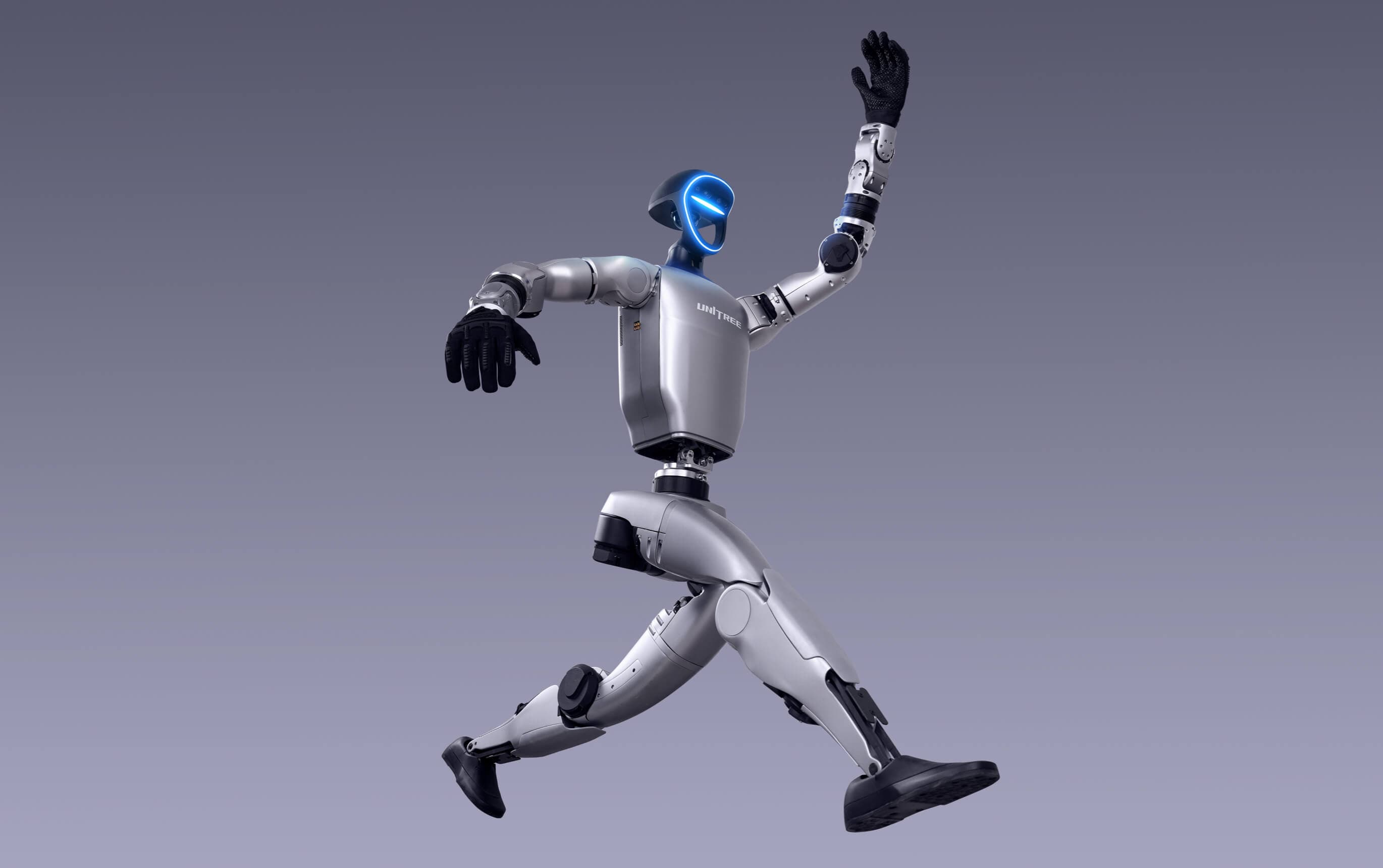
Story
Unitree G1 is the company's bet that the humanoid market is bigger than the H1 product was sized for. Smaller, lighter, listed at $13,500 USD for the base configuration — and aimed at research labs and prosumer buyers who couldn't justify the bigger robot's higher entry point. Unitree's Chinese official page now adds a separate ¥85,000 China-market starting price; HumanoidRoster keeps that local-market price separate from export MSRP because taxes, shipping, exchange rates, and channels can differ.
The dimensions matter: G1 is a 1320 mm robot. That puts it below human size but above industrial-arm size, into a category that doesn't really have an analog in Western product lines. Unitree is testing whether the market exists at that form factor and that price.
Unitree also publishes an English SDK Development Guide with developer-compute, interface, sensor, and safety details for G1/G1-EDU. It improves the profile's transparency around secondary development while explicitly warning that the motion-control computer is not open, that users should keep a safe distance, and that dangerous modifications or intense balance/running tests with the dexterous hand attached should be avoided.
New research and pilot evidence broadens the picture without changing the score. SAP describes an ongoing Arçelik-LG inbound-logistics proof of concept, while POT-VLA, FlashSAC, adaptive-margin navigation, and RynnBrain-VLA report bounded author-run manipulation, locomotion, navigation, and chair-pulling results on G1 hardware. Modified sensing or hand configurations, external compute, method-specific evaluation choices, and missing intervention or safety protocols keep those results in the research-evidence tier rather than proving stock-robot autonomy or production deployment.
G1 is also appearing in the developer-tooling ecosystem around NVIDIA Isaac GR00T: Engineering.com reported that the Isaac GR00T platform and reference workflow for Unitree G1 are expected to become available through GitHub and Hugging Face. That is useful context for researchers and developers, but it is not treated here as evidence of autonomous production deployment.
The Reality Score is held back by the same transparency asymmetry as H1 — Western verification of Chinese hardware claims runs on a longer feedback loop. The commercial traction score is high because G1 actually ships at a public price, and The New Yorker has now reported that Unitree shipped more than 5,000 G1 humanoids in 2025. HumanoidRoster treats that shipment figure as Tier B reporting until Unitree or audited filings publish the same number, and it does not turn staged kung-fu or movement footage into autonomous deployment evidence.
Reality check
G1 ships at a starting price of $13,500 USD with a published spec sheet. Unitree now also shows official voice-driven, real-time action-generation demos. The smaller-than-human form factor is either the point or the limitation depending on the use case; independent verification remains thinner than the public product data.
- Manufacturer MSRP starts at $13,500 USD for the standard G1; Unitree's Chinese product page separately lists a China-market starting price of ¥85,000
- Manufacturer spec sheet — 1320 mm standing, ~35 kg with battery, 2 kg arm payload, 23 DoF, ~2 hr runtime; Unitree's Chinese page lists 23–43 joint motors, depth camera + 3D LiDAR, 4-microphone array, Wi-Fi 6 / Bluetooth 5.2, and optional Dex3-1 hand details for EDU configurations
- Ships to research labs and prosumer buyers worldwide
- EDU variant supports up to 43 DoF with optional dexterous hand and Nvidia Jetson Orin compute
- Unitree published a May 2026 G1 demo showing natural-language voice prompts generating varied actions in real time
- NVIDIA/Engineering.com reporting around the Isaac GR00T reference humanoid robot says the Isaac GR00T platform and reference workflow for Unitree G1 are expected to become available to robot developers on GitHub and Hugging Face; HumanoidRoster treats this as developer-platform ecosystem support, not as proof of G1 production autonomy or customer deployment
- Unitree's official English G1 SDK Development Guide, last updated 2026-05-06, documents G1 and G1-EDU developer details including G1 23 DoF, G1-EDU 23-43 DoF, optional Dex3-1 7-DoF three-finger hand plus optional wrist DoF, Jetson Orin NX development computer with 16 GB memory and 2 TB storage, 2x Gigabit Ethernet, 3x USB 3.0 Type-C, USB 3.2/DP 1.4 Type-C, 58 V / 24 V / 12 V power outputs, Livox MID360 LiDAR, Intel RealSense D435i depth camera, and Unitree joint motors with maximum torque listed as 120 N·m
- The New Yorker reported in June 2026 that Unitree shipped more than 5,000 G1 humanoids in 2025
- IEEE Spectrum reported that GMO AI & Robotics is using Unitree G1 robots with Japan Airlines in a Haneda airport cargo-container loading/unloading trial
- A peer-reviewed Nature study published July 8, 2026 evaluated a custom teleoperated laparoscopic framework built around Unitree G1 hardware; the researchers completed two live porcine cholecystectomies without conversion to conventional laparoscopy or open surgery
- The independent EgoHTR preprint introduced 55 scene-aligned human-terrain motion sequences totaling more than 150,000 frames and used selected sequences to train per-clip PPO perceptive-locomotion policies; the authors demonstrated atomic-beam and box-up reference motions on Unitree G1 hardware
- SAP reports an ongoing proof of concept at Arçelik-LG in which SAP EWM tasks are routed through FairConsult 24|7 fleet management to a Unitree G1 that scans barcodes, transports materials, and sends confirmations back to SAP; SAP presents reduced manual intervention and elimination of placement errors as potential benefits rather than measured outcomes
- A 2026 POT-VLA preprint reports that a Unitree G1 fitted with a Dex3-1 dexterous hand and a head-mounted RGB-D camera completed 71 of 80 trials across eight real-world task families without human intervention within a predefined timeout and retry budget, compared with 39 of 80 for a direct GR00T-N1.7 baseline using the same embodiment and runtime. POT-VLA used an object-token-fine-tuned checkpoint while the direct variant used the direct checkpoint. The tasks covered cart transport and placement, a chip box and balls placed into baskets, cup stacking, garments placed into a laundry basket, drawer/tray place-and-close, tabletop sorting, and close-range drink handover
- A Holiday Robotics-led FlashSAC preprint reports sim-to-real blind locomotion on a 29-DoF Unitree G1: stable flat-terrain locomotion after about 20 minutes of simulation training versus about 3 hours for PPO, forward/backward/lateral movement without retraining, and climbing a previously unseen 15 cm stair configuration after about 4 hours versus nearly 20 hours for PPO
- A July 2026 NYU Abu Dhabi preprint reports that a context-conditioned safety critic trained in simulation transferred without task-specific tuning to a Unitree G1 fitted with an Intel RealSense D435i; across 10 PointGoal episodes in each real-world scene, the authors report 10/10 successes in a corridor, 10/10 in an apartment, and 8/10 in a cluttered laboratory, versus 10/10, 9/10, and 6/10 for the NavDP baseline
- A July 2026 DAMO Academy and Hupan Lab preprint reports running RynnBrain-VLA on a Unitree G1 through a locally connected RTX 4090 workstation and the SONIC whole-body controller; in 20 author-run Pull the Chair trials with randomized initial object placement, the paper reports 90% success for RynnBrain-VLA versus 75% for GR00T N1.7 using the same SONIC controller
- A HIVE Robots and Technical University of Denmark preprint evaluated a modified Unitree G1-EDU with one head camera and two wrist cameras on a supermarket chip-bag restocking task using GR00T N1.6. From 81 teleoperated demonstrations totaling about 51.5 minutes, the authors report 0/50 successes for naive supervised fine-tuning, 16/50 for their data-engineered policy, 21/50 after one RECAP refinement iteration, and 11/50 after a second iteration
- The Extreme-RGMT preprint reports deploying a 29-DoF motion-tracking controller on Unitree G1 at 50 Hz with a 500 Hz low-level controller. Across four representative motions and five trials per motion, the authors report 90% success for fixed AMASS replay, 85% for highly dynamic online Xsens teleoperation, and 100% for generalist online Xsens teleoperation
- A July 2026 hybrid-motion-prior preprint reports zero-shot transfer of a velocity-tracking policy to Unitree G1 without additional real-world fine-tuning; the paper shows walking with turns and sidestepping over one continuous hardware rollout
- The PAC-MAN preprint reports that a Unitree G1 fitted with a head-mounted ZED Mini dodged 19 of 20 frontal physical ball throws, with one hit and no falls. The deployed policy used onboard segmentation-masked depth and proprioception without ground-truth ball state, an explicit ball-velocity estimate, or a runtime control-barrier filter; an EfficientTAM track was manually initialized from a clicked foreground point
- The X-NavDP preprint reports 10 physical Unitree G1 navigation trials in each of a lab, hall, and office, with success rates of 50%, 50%, and 80%, versus 0%, 20%, and 0% for its NavDP base-policy comparison. X-NavDP was post-trained jointly across wheeled, quadruped, and humanoid embodiments in simulation and deployed through a hierarchy in which the diffusion policy outputs waypoints, MPC converts them to base-velocity commands, and an embodiment-specific pretrained locomotion policy executes them
- A July 2026 P³ preprint reports real-world deployment of a terrain-locomotion policy on a 29-DoF Unitree G1. Across 10 author-run attempts in each terrain category, P³ completed 8/10 stepping-stone trials, 9/10 stair trials, and 10/10 gap trials; the paper's single-sample VAE baseline completed 6/10, 7/10, and 7/10, while its 50-sample Monte Carlo baseline completed 8/10, 7/10, and 9/10.
- The GLAD arXiv v3 author team reports 19 successful course completions in 20 physical Unitree G1 trials: 4/5 on alternating stepping stones and 5/5 each on a staircase-gap course, a 70 cm gap, and an obstacle-rich route. Success required course completion without a fall or human intervention. The same protocol produced 19/20 for AME-GC and 18/20 for AME. The 29-DoF research G1 used a Livox Mid-360, FAST-LIO LiDAR-inertial state estimation, a robot-centric elevation map, and an external RTX 5090 laptop, with mapping and policy control at 50 Hz.
- The peer-reviewed SONIC paper reports 123/124 successful one-trial-per-sequence real-hardware reference-motion tracking tests on Unitree G1. With a GR00T N1.5 VLA fine-tuned on teleoperated data, the physical G1 then completed strict-binary trials across five task groupings and six reported variants: 18/20 apple-to-plate, 15/20 carrot pickup, 19/20 scrub pickup, 7/10 pedal-trash-can opening, 6/10 soda-can-to-trash, and 7/10 drill-and-box relocation. The pedal-trash-can trial is explicitly described as closed-loop; the authors state that the reported VLA executions were fully autonomous with no human intervention during execution.
- The CMU/Bosch APEX arXiv v3 author team reports zero-shot sim-to-real high-platform traversal on a 29-DoF Unitree G1 using LiDAR elevation mapping. Specialized policies succeeded in 44/45 climb-up trials across 0.6, 0.7, and 0.8 m platforms and three approach-angle ranges, plus 5/5 climb-down trials from 0.8 m, 5/5 stand-ups, and 5/5 lie-downs. The distilled policy was also demonstrated traversing 0.8 m platforms while switching among six skills from local geometry and externally supplied linear and yaw-velocity commands, including two consecutive physical full-skill cycles.
- ZEALS reports that it and University of Tsukuba startup Quick tested a Unitree G1 running Omakase OS in the first-floor lobby of Tsukuba University Hospital from 19:00 to 21:00 on March 23–25, 2026. ZEALS says the after-hours PoC completed checks for bipedal stability, obstacle avoidance, autonomous point-to-point walking, conversational guidance and carrying, and anomaly detection, with no falls and one peripheral-power interruption before all checks were completed; it publishes no trial counts, route lengths, task-success denominators, independent hospital results, or teleoperation, safety-supervisor, intervention, or emergency-assistance protocol.
- A Caltech-led preprint reports zero-shot transfer to Unitree G1 of policies generated with contact-implicit direct simulation-based multiple shooting. Hardware demonstrations include an approximately 180-degree jump-turn plus command-conditioned crawling forward and backward through constrained indoor spaces and rough patches and uphill on grass; the companion project page also shows a long cluttered-lab run in which an operator supplied real-time twist commands rather than waypoints. The authors report no real-world fine-tuning but publish no hardware trial count or hardware success rate.
- A Siemens-authored fail-passive-gap preprint reports 12 induced communication-loss trials on a Unitree G1 EDU pick-and-place cell: three trials each using access-point power-off, antenna disconnect, wired-uplink disconnect, and fail-safe CPU stop. The robot reached a stable balanced standstill without toppling in every trial in 0.5–1.3 seconds. The authors explicitly do not claim end-to-end PL e / SIL 3 certification: the robot-side reaction depends on non-safety-rated onboard compute and a proprietary balancing policy with no established PFHD, diagnostic coverage, or common-cause-failure characterization, while reliability, packet-loss-margin, availability, and full stopping-distance work remain open.
- A 2026 NTU/PKU/BAAI/HKUST(GZ) preprint reports that a Unitree G1 fitted with Inspire DexHands autonomously executed an 11-task household loco-manipulation suite under one ω-0 policy. With 10 real-robot trials per task, the authors report 81.8% overall success and 90.3% task progress for the Omni variant. They state that evaluation rollouts used no human teleoperation, motion replay, or scripted intervention. Training used teleoperated demonstrations, including 2,220 trajectories across the 11 downstream tasks, and the project page reports a 40.3-hour, 4,827-episode ω-HOME dataset spanning 24 tasks. Five locomotion-heavy Omni tasks used exocentric observations rather than onboard-only vision.
- A 2026 Harbin Institute of Technology preprint evaluated the KILVO localization stack on a Unitree G1 carrying a custom camera, LiDAR, IMU, and encoder suite. Across 15 indoor, outdoor, running, and robustness sequences, the authors report 0.0145 m mean end-to-end translation error, the best result in 8 of 15 sequences, about 14 ms average processing time, and 1 kHz state output. In a deliberately corrupted 375-second recorded sequence containing separate 10-second encoder, LiDAR, and camera outages, KILVO returned to full-modality operation and ended with 0.0165 m translation error.
- The ¥85,000 China-market starting price should not be converted into or substituted for export MSRP without a dated exchange-rate/source policy and export-channel confirmation
- Marketed task list includes capabilities not yet demonstrated under uncontrolled conditions
- Voice-driven action-generation demos are company-published demonstrations, not independent evidence of robust deployment
- Isaac GR00T workflow support is developer-platform evidence, not independent evidence of G1 production autonomy, customer deployment, or task robustness
- Unitree's G1 SDK Development Guide warns that G1 is a powerful civilian robot, the motion-control computer is not open to developers, only the development unit should be used for secondary development, users should maintain a safe distance, avoid dangerous modifications, and avoid intense actions such as running or balance tests with the dexterous hand attached
- Choreographed public demos should not be counted as autonomous capability; The New Yorker described the February 2026 G1 kung-fu display as preprogrammed and likely motion-capture-derived
- The Japan Airlines/GMO Haneda example is journalism about a trial using G1 robots; it should not be interpreted as independent proof of autonomous airport-cargo deployment, production readiness, uptime, task-completion rate, safety record, or broad Japan-market legality/compliance
- The Nature surgical study used a custom teleoperation framework, wristed instruments, external calibration, and human surgeons; it does not demonstrate autonomous surgery, stock-G1 surgical capability, human-patient use, clinical readiness, or general-purpose hospital deployment
- EgoHTR hardware results use a separate expert policy for each selected reference clip, a retargeted reference command, and a terrain-height scan; they do not show that a stock G1 can autonomously choose goals or navigate arbitrary unseen rough terrain
- The Arçelik-LG example is an ongoing SAP-described proof of concept with no disclosed start date, trial count, achieved performance metric, customer-side release, or control-mode disclosure; potential workflow benefits are not measured deployment outcomes
- POT-VLA is a new, non-peer-reviewed author evaluation on a modified G1 configuration. Its no-human-intervention criterion operates within a predefined timeout and retry budget, and its POT and direct variants did not use identical learned checkpoints; it is not independent reproduction, stock-G1 capability, or commercial deployment evidence
- FlashSAC is an author-reported preprint result about policy-training time, not production uptime or general autonomy. The unseen claim applies to the physical stair configuration, not the stair category: training already included stair curricula up to 23 cm. The real-world section does not disclose a trial count, human-spotter or intervention protocol, or standardized safety test
- The adaptive-safety-critic result is an author-run, non-peer-reviewed preprint using a modified sensing configuration and only 30 real-world episodes. The paper reports goal success but does not provide independent reproduction, standardized collision or near-miss accounting, human-spotter or intervention disclosure, production uptime, or general-autonomy validation
- RynnBrain-VLA was trained from teleoperated demonstrations and evaluated by its authors in a preprint. The compared methods used method-specific action-chunk lengths, inference ran on an external RTX 4090 workstation, and the paper does not provide independent reproduction, intervention accounting, standardized safety metrics, or customer-deployment evidence
- The DEED retail-restocking result is an author-run, non-peer-reviewed, single-task evaluation on a modified G1-EDU using one chip type and 50 episodes per condition. Autonomous rollouts and human corrections were added to training; this is not stock-G1 capability or unattended store-deployment proof. The 16/50 and 21/50 confidence intervals overlapped substantially, both refined policies managed only one consecutive bag before manual reset, and the second refinement iteration regressed to 11/50
- Extreme-RGMT uses fixed supplied AMASS motion-reference replay in one condition and live inertial motion-capture teleoperation in both Xsens conditions. The small, selected, author-run motion sets do not demonstrate task autonomy, autonomous skill selection, production safety, independent replication, or customer deployment
- The hybrid-motion-prior paper provides one qualitative continuous real-G1 rollout and does not disclose its duration, a hardware trial count, hardware fall rate, spotter or intervention protocol, or independent reproduction. The authors report visible walking and turning oscillations; the paper's numerical fall rates, recovery timing, and tracking errors come from simulation rather than the physical robot.
- PAC-MAN is an author-run preprint result on a G1 equipped with a head-mounted ZED Mini and the research control stack, not independent safety certification or general collision-avoidance proof. A human click initialized the target tracker, and the balls were thrown by hand; the paper does not report throw randomization, blind evaluation, or external replication. The paper describes policy execution rather than robot teleoperation, but does not disclose tracker re-initialization frequency, spotter, intervention, abort, or manual-reset accounting
- X-NavDP is an arXiv v1 author-team preprint with no external publication DOI or journal reference in current arXiv metadata and only 10 G1 trials per scene. It relies on a predefined embodiment-specific low-level locomotion policy and provides no independent reproduction or production-safety accounting. Narrow-passage failures are explicitly attributed to G1; long-detour and transparent- or hollow-obstacle failures are broader system limitations, not reported as a breakdown of the 12 failed G1 episodes. The paper describes closed-loop policy execution and does not report teleoperation, but operator, spotter, intervention, abort, and reset accounting are undisclosed
- The P³ result is an arXiv v1 author evaluation with 10 attempts per terrain category. The paper does not disclose standardized physical terrain dimensions for the reported hardware trials, operator command protocol, spotter presence, intervention/abort/reset accounting, fall or near-miss accounting, or independent reproduction. External RTX 5090 inference and the added LiDAR/elevation-map stack are part of the research setup. Policy-driven terrain traversal is not autonomous task selection, customer operation, production uptime, or proof that a stock G1 achieves the same result.
- GLAD is an author-run, non-peer-reviewed preprint evaluation with only five attempts per physical terrain. The authors say the short physical courses create a ceiling effect, and all observed failures occurred on alternating stepping stones, where LiDAR mixed-pixel artifacts blurred map boundaries. The policy followed supplied forward-velocity commands; no intervention during successful traversal is not the same as autonomous route selection, general navigation, stock-G1 performance, customer deployment, production safety, or independent replication.
- SONIC is a peer-reviewed but author-run evaluation on one G1 platform. Its 123/124 result measures reference-motion tracking, not task autonomy, and its gamepad, video, and VR modes are command-driven or teleoperated. The no-human-intervention statement applies to the reported GR00T VLA test executions, whose training data were collected through teleoperation. The paper does not provide independent replication, customer-deployment evidence, or a formal treatment of safety and energy efficiency for extended deployments.
- APEX is an author-run arXiv v3 preprint with no external publication DOI or journal reference and no independent replication. The 44/45 and 5/5 figures evaluate specialized single-skill policies. The paper reports 95.4% over more than 1,000 end-to-end simulation trials and demonstrates two consecutive physical full-skill cycles, but does not publish a repeated, quantified real-hardware full-sequence success rate. Geometry-driven skill selection under externally supplied linear and yaw-velocity commands is not autonomous mission navigation or general autonomy; stand-up and lie-down are user-triggered, and the paper does not report teleoperation of the deployed low-level policy.