Story
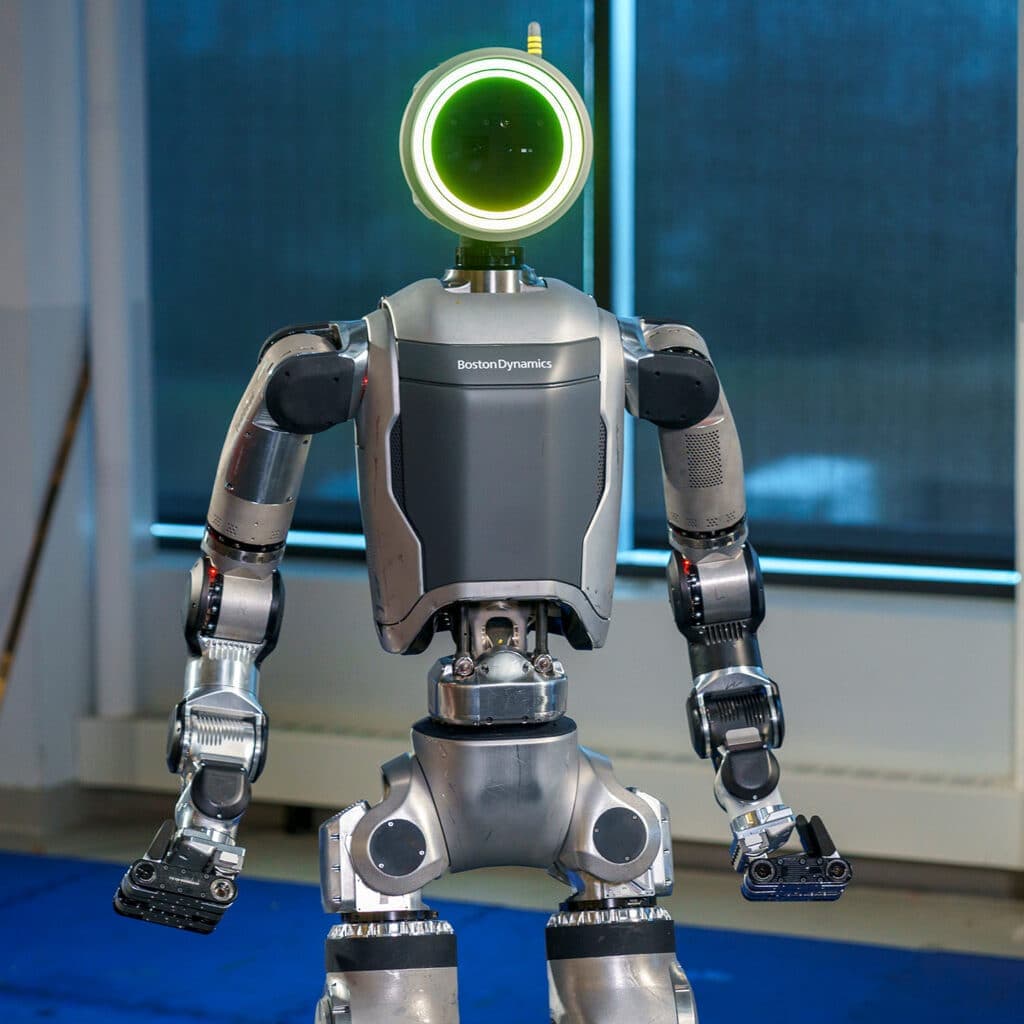
The hydraulic Atlas, retired in April 2024 after eleven years, was the best-known robot in the world. Its successor is electric, taller, and quieter. The reveal video is unforgettable for one specific reason: it shows the new Atlas getting up off the floor by rotating its legs and torso in ways no human body can.
Boston Dynamics has the deepest hardware lineage in humanoid robotics. Spot proved that a quadruped could leave the lab. Atlas proved that a humanoid could parkour. The all-electric platform is the company's bet that the next decade is about production, not perception — and that the hydraulic legacy was holding it back on weight, noise, and cost. The published spec sheet — fifty-six degrees of freedom, thirty kilograms of sustained payload, four hours on a battery, IP67-rated — frames Atlas as enterprise-grade hardware rather than a research demo. Boston Dynamics' January 2026 product-version launch added a stronger transition signal: the company said manufacturing would begin immediately, all 2026 deployments were fully committed, and initial fleets were scheduled for Hyundai RMAC and Google DeepMind. It also added industrial-integration context around 2.3 m reach, 50 kg lift-capacity wording, -20°C to 40°C operating temperature, Orbit MES/WMS integration, barcode/RFID workflows, human-detection/fenceless safety framing, and autonomous/teleoperated/tablet-steering control modes. Boston Dynamics' May 2026 training write-up adds useful context around the mini-fridge demo: the company says Atlas rotates its torso, squats, lifts the appliance-scale object, and carries it to a person while using arms, legs, and torso for the lift. The June 2026 Atlas Goes Hands On page adds a more concrete manipulation/autonomy example: Boston Dynamics says Atlas moved engine covers between supplier containers and a mobile sequencing dolly from bin-location inputs with no prescribed or teleoperated movements, while reacting online to moving fixtures, insertion failures, trips, and collisions. HumanoidRoster treats that as controlled manufacturing-style evidence, not production-line validation. Boston Dynamics' June 2026 Waltham expansion announcement adds manufacturing and workforce-training infrastructure context for Atlas, Spot, and Stretch, while still not proving Atlas shipped-unit ... [truncated]
What it has not done yet is publish customer-side operating evidence. Hyundai RMAC and Google DeepMind are now manufacturer-named initial fleet destinations, which is enough for a conservative pilot-stage label, but not enough to call Atlas broadly commercial or independently validated. The Reality Score reflects the gap between hardware credibility and customer-side proof.
Reality check
The hardware lineage is unmatched and Boston Dynamics now publishes a real spec sheet for Atlas. The electric platform still scores below verified external pilots because Hyundai-internal use is not the same as customer deployment.
- All-electric platform replaces the hydraulic Atlas (2013–2024)
- Hyundai is the parent and a planned internal user
- Boston Dynamics' Atlas spec sheet lists 1.9 m height, 90 kg weight, 30 kg sustained weight capacity, 56 DoF, IP67, four hours of battery life, two hours of battery life with heavy lifting, a three-minute autonomous battery-swap time, a 1.5-hour charge time, and 110 V charging input with 220 V optional. Boston Dynamics' accompanying article describes the four-hour figure as typical use and says Atlas can autonomously swap its own batteries in less than three minutes
- Boston Dynamics says all of Atlas' limbs can be replaced in the field in under five minutes
- Official Boston Dynamics footage shows Atlas rotating, squatting, lifting, and carrying a mini-fridge to a person
- Boston Dynamics' official May/June 2026 School of Football material shows Atlas performing football-inspired movement drills, including basic footwork/feint work in a lab setting, and frames football movement as training inspiration for humanoid control
- Reveal video showed full-body articulation no other humanoid matches publicly
- Boston Dynamics announced the product version of electric Atlas at CES 2026, said manufacturing would begin immediately, said all 2026 deployments were fully committed, and named initial fleets for Hyundai's Robotics Metaplant Application Center and Google DeepMind
- Boston Dynamics' January 2026 launch article lists official industrial-integration details including 2.3 m reach, 50 kg lift-capacity wording, -20°C to 40°C operating temperature, human-detection/fenceless safety framing, Orbit MES/WMS integration, barcode/RFID workflow integration, and autonomous, teleoperated, and tablet-steering control modes
- Boston Dynamics' official Atlas Goes Hands On video says Atlas autonomously moved engine covers between supplier containers and a mobile sequencing dolly from bin-location inputs, with no prescribed or teleoperated movements and with online motion generation responding to moving fixtures, insertion failures, tripping, and collisions using vision, force, and proprioceptive sensing
- Hyundai Mobis announced at CES 2026 that it will supply actuators for Atlas under a strategic collaboration with Boston Dynamics, and said the collaboration supports Boston Dynamics and Hyundai Motor Group mass-production plans for Atlas
- In a July 2026 deployment retrospective, Boston Dynamics said its first Atlas deployment took place at the Hyundai Metaplant "last year" (2025) while discussing tests outside controlled environments
- Hyundai Motor Group said it plans a U.S. robot-production facility with annual capacity of up to 30,000 units by 2028 and plans to deploy Atlas first at production facilities including Hyundai Motor Group Metaplant America before phased expansion
- Internal Hyundai use is being framed as "commercial deployment" — it is not the same as external customer adoption
- Demo-to-production ratio for the publicly shown footage is opaque
- The football videos are staged promotional/demo footage, not proof of customer deployment, production-line operation, or general-purpose sports autonomy
- Boston Dynamics' committed 2026 fleet language is an official manufacturer transition signal, not customer-side confirmation of shipped unit counts, operating hours, task completion, autonomy rate, safety incidents, or broad commercial adoption
- The January 2026 launch article's 50 kg lift-capacity wording should not replace the existing 30 kg sustained payload spec without a clear semantics match to the spec-sheet payload field
- The Atlas Goes Hands On engine-cover demo is official Boston Dynamics evidence in a controlled manufacturing-style setting, not customer-side production throughput, uptime, safety, or deployment validation
- Boston Dynamics announced a 323,000 square foot Waltham advanced robotics and AI center that supports manufacturing, workforce training, and operations for Atlas, Spot, and Stretch, but facility investment is not proof of Atlas shipped-unit counts, customer operating hours, task performance, autonomy rate, safety metrics, or broad commercial adoption
- The Hyundai Mobis actuator-supply announcement is supply-chain and manufacturing-readiness evidence only; it does not prove Atlas shipped-unit counts, customer operating hours, task performance, autonomy rate, safety metrics, or broad commercial adoption
- Hyundai Motor Group's 30,000-unit figure is a forward-looking aggregate U.S. robot-facility capacity target, not achieved output or an Atlas-only allocation; the stated initial Metaplant deployment plan does not prove factory completion, delivered units, customer operation, task performance, uptime, safety, or autonomy
- The reported 2027 Atlas pilot is with an unnamed global company and is not a completed pilot or disclosed signed order. The outlet describes it as a "first pilot test," but does not define the scope of "first"; Boston Dynamics already calls Hyundai field testing Atlas's first customer pilot and has announced 2026 fleets for Hyundai RMAC and Google DeepMind. Do not interpret the report as Atlas's first-ever pilot, first customer pilot, or first external deployment. Client-fleet skill sharing is a reported product description rather than a published field result, and handheld-controller operation remains under consideration rather than a shipped control mode.